
Our Why
South Africa’s public health system is in a deep crisis, shaped by social, economic, and structural inequalities embedded within it. The history of apartheid and the unequal distribution of resources continues to weigh heavily on historically marginalized communities. Inadequate housing, overcrowding, limited access to clinics and hospitals, unemployment, gender-based violence, mental health challenges, and ongoing trauma all combine to create severe barriers to well-being.
In many townships, such as Gugulethu and Khayelitsha, access to healthcare remains deeply lacking. Families often queue for hours at overcrowded and underfunded clinics, only to be referred across the city for specialized services. For people who lack stable forms of income, seeking treatment often means having to take time off of work, thus losing income that is vital to their and their families’ well-being and survival. Larger hospitals are also scarce in these neighborhoods, and smaller local facilities are unable to respond to the community’s needs.
Community members have long advocated for better services. In 2013, when the GF Jooste Hospital closed, Gugulethu lost its only public hospital. Local citizens have been fighting for another one ever since, but change has been slow. In practice, much of the support that exists comes not from the formal health system but from community care networks: local forums, mutual aid initiatives, storytelling campaigns, and grassroots organisations like MCSJ and its allies. These networks provide vital spaces for advocacy, psychosocial support, and collective problem-solving, but they remain fragile and under-resourced.
However, despite these struggles with healthcare services, the current moment also presents an opportunity. In 2024, the National Health Insurance Bill was signed into law, signalling renewed recognition of the need for systemic reform. Though full implementation may take decades, this bill creates openings to rethink healthcare delivery in ways that integrate and strengthen community-based care networks alongside formal systems.
It is in this context—where public provision is weak and grassroots responses are essential—that our work is located. By strengthening community networks, building bridges with formal healthcare structures, and addressing the wider social conditions that shape people’s health, we aim to create pathways for more equitable and accessible healthcare in Gugulethu, Khayelitsha, and beyond.






The MCSJ Strategy
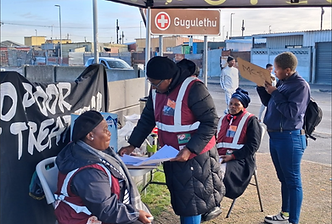
MCSJ focuses on addressing public health and safety for all people. Though our focus is primarily in the Gugulethu and Khayelitsha neighbourhoods, we hope our work can have positive impacts beyond as well. Much of our current advocacy is focused on building a district public hospital in Gugulethu, but we understand that the mere provision of another hospital will not be enough to translate to improved health and safety in our community. The needs of the community extend beyond infrastructure and health services, and instead rely heavily on care networks.
Community care networks provide education and support where public health alone cannot deliver. Our organisation does this by bringing people together in forums, dialogues, and learning sessions. These sessions cover topics like how people can best engage in issues relating to men’s health, mental health and well-being, gender-based violence, youth issues, and safety on the streets. Outside of enabling and enhancing local care networks, we also engage in cross-sector research collaborations and solidarity for other campaigns related to anti-corruption, land, and housing.
MCSJ does not aim to focus solely on a singular health problem or affected population—our goal is to support people and communities across various health and social issues, wherever we are needed.
Our Story
Load-Shedding Campaign with #UniteBehind
Community mobilization for Zackie Achmat’s ZA2024 Campaign
Cry of the Xcluded campaign
Bicycle Empowerment for Neighborhood Watch Patrollers Program
Hospital Campaign Protest at Parliament
Our Constitution
Strategic Objectives:
Community health
"To facilitate processes that will lead to greater access to health services and therefore to healthier environments and communities."
Building community capacity
"To empower the community to better understand their constitutional and related rights in order to help them make their demands more informed."
Addressing community infrastructure
"To mobilize the community to advocate for the improvement of the infrastructure in order to secure a safer living environment."
Building partnerships
"To establish and build partnerships with like-minded stakeholders in order to maximize the positive impact on the community's living conditions."